MARKET OUTLOOK
What Happened to the AI-Run Vaults? Almanak, Giza and Theoriq, One Year On
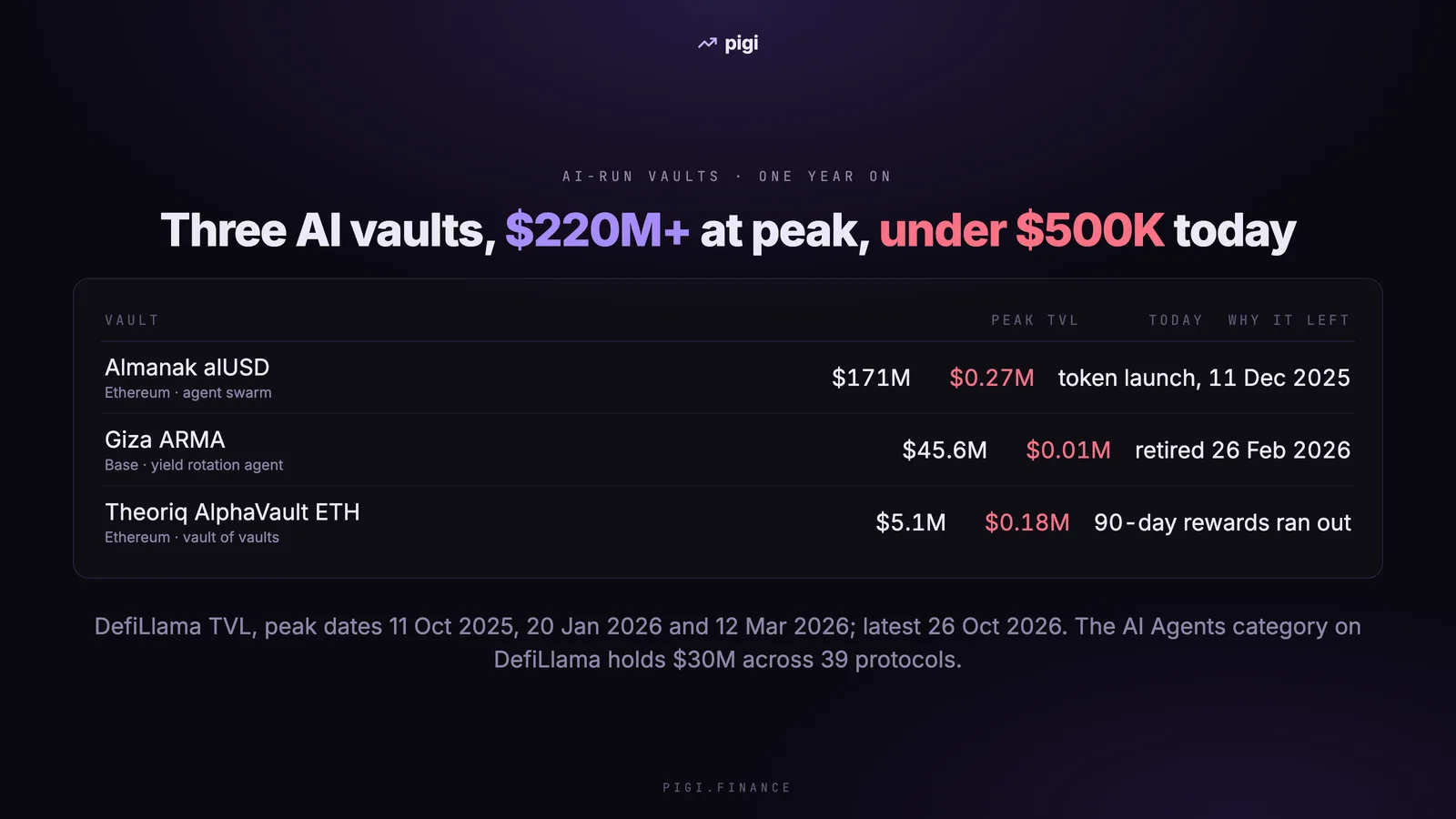
In 2025 three projects told depositors that an AI agent would manage their DeFi yield better than a human curator. Between them they attracted more than $220M at their peaks. In October 2026 they hold under $500K combined. This article follows the money with dated TVL series, the projects' own announcements and pigi's data, and asks what a vault rating would have caught.
The Short Version
- Almanak's alUSD vault peaked at $171M on 11 October 2025 and lost 92% of its TVL in the ten days after its token launched on 11 December. The depositors were points farmers waiting for the airdrop.
- Giza's ARMA agent peaked at $45.6M on 20 January 2026. Giza retired it on 26 February and gave as its first reason that APR falls as deposit size grows. Funds went back to users' wallets; the successor agent shows about $13K.
- Theoriq's AlphaVault ETH peaked at $5.1M on 12 March 2026, as a three-month THQ rewards campaign that began on 6 December ran out. It was down 90% by 31 March. The company changed CEO on 4 May and now describes AI as a tool its human curators use.
- None of the three lost money to an exploit. The capital left on schedule: when the token unlocked, when the agent was switched off, when the rewards stopped.
- DefiLlama's AI Agents category holds about $30M across 39 protocols. The on-chain capital allocator category it set out to disrupt holds $9.3B.
- pigi tracks AlphaVault ETH and rates it D, 43 out of 100. The vault it allocated to at launch is rated F.
Figures were checked on 26 October 2026 against DefiLlama's daily TVL series, the projects' own blogs and documentation, and pigi's data. TVL moves daily; treat every figure as a snapshot.
What Was Promised
The label was "DeFAI", and the pitch was the same in each case: the work a vault curator does, picking venues, sizing positions, rebalancing and exiting, can be done by software that never sleeps and never gets attached to a position. Three projects shipped three versions of it.
- Almanak described a "swarm" of specialised agents, a strategist, a coder, a reviewer, a QA engineer and a deployer, that design, test and deploy strategies into vaults built on Lagoon's ERC-7540 contracts. Its flagship was Autonomous Liquidity USD, alUSD, a vault on Ethereum whose rotator agent moved USDC between Aave v3, Compound v3, Fluid, Euler v2, Morpho Blue, Yearn v3 and Curve, trading only when the projected gain covered the cost.
- Giza ran ARMA, a self-custodial agent on Base that rotated stablecoins between Aave, Morpho, Compound and Moonwell from the user's own smart account, with the decision logic on Giza's servers. A second agent, Pulse, moved stETH into Pendle markets with Lido. In 2025 Bankless summarised the offer as "ARMA delivers 15% on USDC" with $20M under management.
- Theoriq launched AlphaVault ETH in December 2025 on Mellow as an "AI-curated vault-of-vaults": an allocator agent spreading ETH across sub-vaults, with covariance estimation, position caps, a cash buffer and a minimum-variance fallback. Its two sub-vaults at launch were Lido's stRATEGY vault, curated by Mellow, and Chorus One's MEV Max vault on StakeWise.
In every case the AI was the product and the venues underneath were ordinary lending markets and staking vaults. That matters for what follows: the yield these agents could earn was bounded by the same markets everyone else was using.
| Almanak alUSD | Giza ARMA | Theoriq AlphaVault ETH | |
|---|---|---|---|
| Where | Ethereum, ERC-7540 vault on Lagoon | Base, the user's smart account | Ethereum, Mellow vault |
| What the agent did | Rotated USDC across lending markets | Rotated stablecoins across lending markets | Allocated ETH across sub-vaults |
| Peak TVL | $171.1M on 11 Oct 2025 | $45.6M on 20 Jan 2026 | $5.1M on 12 Mar 2026 |
| TVL on 26 Oct 2026 | $0.27M | $0.01M | $0.18M |
| What happened | Token launched 11 Dec 2025 | Retired 26 Feb 2026 | 90-day rewards campaign ended, March 2026 |
Almanak: The Token Launch
Almanak's TVL curve is a points schedule drawn in dollars. A pre-season ran from January to June 2025 and distributed a million points. Season 1 opened on 14 July with 150,000 points a day, stepped up to 333,000 a day on 14 August, and ran at that rate through a third stage that ended on 11 December. DefiLlama's month-end TVL followed the emissions: $0.3M at the end of June, $11M in July, $38M in August, $93M in September, $143M in October, with the peak of $171M on 11 October.
The terms were public. Points would convert to ALMANAK tokens at roughly one to one, the airdrop was 45% of a 33% community allocation, and the whole of it unlocked at the token generation event. Writing on 10 November 2025, with the vault at about $100M, 13,000 users and a 6.2% yield, Oak Research called the post-launch correction in advance: airdrop participants would take profits, and the number to watch was whether TVL held after the TGE.
It did not. The token launched on 11 December 2025.
| Date | Almanak TVL | Event |
|---|---|---|
| 10 Dec 2025 | $126.6M | Last day of points |
| 11 Dec 2025 | $125.8M | Token generation event, airdrop claimable |
| 12 Dec 2025 | $69.8M | |
| 13 Dec 2025 | $34.8M | |
| 20 Dec 2025 | $9.8M | |
| 31 Dec 2025 | $6.3M | |
| 30 Apr 2026 | $0.55M | |
| 26 Oct 2026 | $0.27M |
Nothing broke. The vault's agent kept running and the yield never went negative. The depositors had been paid in points to be there, and they left the week the points became tokens. A year later Almanak's homepage pitches agents that "trade and earn yield across stocks, commodities, and crypto", and the alUSD vault page shows an estimated yield under 2% on a few hundred thousand dollars.
Incentive-driven TVL is not a secret. The schedule was published, the unlock date was published, and the exit happened on that date. This is why pigi's yield figures leave the incentive layer out, as explained in Where to Get Even Higher Yields?
Giza ARMA: The Yield That Shrank
ARMA was the best-known of the three agents and the one with the most credible product: it ran from the user's own smart account on Base, so Giza never held the money. DefiLlama shows $28M at the end of October 2025, $38M at the end of December and a peak of $45.6M on 20 January 2026, while GIZA token rewards were being paid to ARMA depositors and a second airdrop season was under way.
On 26 February 2026 Giza announced that ARMA and Pulse were being retired and folded into a single rebuilt agent inside a new interface called Giza World. The same day its X account celebrated passing $40M in "assets under agent". The migration guide explains why the new agent would spread deposits across several protocols where ARMA had used one at a time, and the first reason it gives is the whole story in one line:
"APR decreases as deposit size increases. Splitting your capital across protocols keeps you in each one's higher-yield range."
A rotation strategy that moves all of a user's balance into whichever lending market pays most works at $1M and moves the rate against itself at $45M. The second reason was concentration risk, which is the same point from the other side. The guide also noted that GIZA rewards would no longer be paid on ARMA and Pulse, set a migration deadline of 26 March, and promised that unmigrated funds would be returned automatically.
| Date | Giza TVL | Event |
|---|---|---|
| 20 Jan 2026 | $45.6M | Peak |
| 26 Feb 2026 | $21.0M | Retirement announced |
| 8 Mar 2026 | $9.1M | |
| 16 Mar 2026 | $24.6M | New agent's deposits appear in the series |
| 26 Mar 2026 | $17.0M | Migration deadline |
| 31 Mar 2026 | $9.9M | |
| 31 May 2026 | $3.5M | |
| 30 Jun 2026 | $0.01M | Flat at about $13K since |
What came after is thinner than what came before. An independent review checked in September 2026 found that the Giza World app replays a data snapshot dated 23 March 2026, that the successor agent has no third-party-verifiable assets or fees, that nothing had been pushed to the company's public code repositories since the same 23 March, and that no third-party audit of ARMA was ever published. The decision logic had always run on Giza-hosted servers: users could verify every transaction and none of the reasoning behind it. The new agent's "Giza Thoughts" feature, a daily log of why it moved or did not, was announced only after the old one was retired.
The agent was switched off by its makers, not by the market, and the reason they gave is the oldest one in asset management: the strategy had a capacity, and the capacity was small.
Theoriq AlphaVault: The 90-Day Campaign
AlphaVault ETH is the smallest of the three and the only one still running as designed, which makes it the cleanest experiment. Theoriq's launch post in December 2025 set out both the product and the incentive. The product expected "high single digit" native ETH yield from its sub-vaults. The incentive was a three-month TVL bootstrapping campaign worth 10 million THQ, one percent of the token supply: a baseline of one THQ a day per $1,000 deposited, which the post itself described as a 10.95% baseline yield, plus a pre-TGE "Nitro" pool of 33,333 THQ a day from 6 December, a post-TGE pool of 22,222 THQ a day distributed through Turtle points, referral multipliers, a staking multiplier of up to three times, and Mellow points on top.
Ninety days from 6 December is early March. DefiLlama shows the vault at $3.1M at the end of February, a peak of $5.1M on 12 March, $1.5M on 20 March and $0.47M on 31 March. There was a one-day return to $2.2M on 2 April, then $0.23M by the end of May and $0.18M on 26 October 2026.
The returns were respectable throughout. Theoriq reports a 4.85% net APY in ETH for the second quarter of 2026 and no negative month in the year. Its Q3 report puts cumulative fees since the December inception at 12.98 tqETH, 9.90 of it from the management fee, and says the monthly rate "has settled well below the launch-period peaks as the fee base normalized". pigi tracks the vault as Theoriq AlphaVault ETH: on 26 October 2026 its share price stood at 1.039, so a depositor from the launch has earned about 3.9% in ETH terms over ten months before any THQ, and its 30-day realised APR was 5.17%.
On 4 May 2026 a new CEO announced a reorganisation: separation from the development partner that had built the agent platform, the discontinuation of the general-purpose agent products, and a pivot to curating tokenized real-world assets, starting with a gold vault. The company's description of itself changed with it. Today it reads: "curators set the strategy and the risk limits, and AI-assisted systems execute and monitor within them." The Q3 report shows what that looks like in practice: a diligence system flagged a warehouse-lending exposure in August and the team exited it at a known cost, and execution moved to bundles that are simulated and policy-checked before a human signs.
AlphaVault's real returns were positive every month of 2026, and that was not enough. Depositors had been offered 10.95% a year in THQ on top. Once the campaign ended, a 4 to 5% ETH yield routed through a vault of vaults could not keep them.
Three Exits, One Pattern
- The money was rented. Points at Almanak, token rewards at Giza, a 90-day THQ campaign at Theoriq. In all three the TVL tracked the emission schedule on the way up and on the way down, and not one of the exits was triggered by a loss.
- The AI never got to compete. Almanak's vault yielded about 6%, AlphaVault under 5%, and ARMA's 15% headline was mostly rewards. Depositors never stayed long enough for the agent's skill to be the reason they were there.
- Capacity, not intelligence, was the constraint. Giza said it in writing: APR falls as deposit size grows. Rotating between the same handful of lending markets is a small-capacity strategy whoever runs it, and no amount of model quality changes the depth of the markets.
- Black boxes empty fast. Off-chain decision logic, no audit, a frozen dashboard. When a depositor cannot verify what the agent is doing, the only safe move is to leave, and they do.
- Every survivor put the humans back in front. Almanak repositioned around user-built agents for stocks and commodities. Giza's successor advertises constraints the user sets. Theoriq's curators set the limits and AI works inside them.
The category as a whole tells the same story. On 26 October 2026 DefiLlama's AI Agents category holds $30.4M across 39 protocols, more than half of it in one project. The on-chain capital allocator category, the human-curated vault platforms these agents were meant to replace, holds $9.3B across Spark, Veda, Grove, Concrete, Upshift and the rest. The agents hold a third of one percent of the market they set out to automate.
What a Rating Would Have Flagged
None of this needed foresight. Every signal was in a launch post, a token document or the chain itself, months before the exit.
| Signal | Where it was visible | Vault |
|---|---|---|
| TVL that depends on incentives | A published points schedule with an end date; a rewards campaign with a 90-day window and a token rate of 10.95% on top of the native yield | Almanak, Theoriq, Giza |
| A dated unlock | Airdrop fully unlocked at the token generation event, announced weeks ahead | Almanak |
| A capacity-limited strategy | All of a deposit allocated to one lending market at a time, in markets whose rate moves with size | Giza |
| An unverifiable operator | Decisions made off-chain on the company's servers, no published audit, no reasoning log | Giza |
| A deep stack | A vault of vaults whose first sub-vault is itself a vault of strategies. pigi rates that sub-vault, Mellow stRATEGY, F, 22 out of 100, once the vaults nested underneath it are flattened and scored | Theoriq |
Two of these are built into how pigi measures vaults. pigi's APR is realised share-price growth with incentives excluded, so a vault whose depositors are being paid in points shows the yield that will remain when the points stop. And pigi's risk bands rate the venue and the structure around it, the protocol, the assets, the oracles, the curator and the vault's own controls, which is why a vault of vaults inherits the weakest layer underneath it. The others are questions any allocator can ask before depositing: when do the incentives end, what unlocks and when, what happens to the rate if the vault doubles, and who can verify the decisions.
"AI-managed" is not a risk factor in itself. The risk factors here were ordinary: incentive dependence, an unlock date, a strategy with no capacity, an operator nobody could check, a stack too deep to see through. The AI label just made people skip the checklist.
Takeaways
- Three AI-run vaults peaked above $220M between them and hold under $500K a year later. No exploit was involved.
- Each exit had a date that was known in advance: a token unlock, a retirement notice, the end of a rewards campaign.
- Native yields were ordinary, 4 to 6%, because the venues underneath were ordinary. An agent cannot earn more than the markets it rotates between.
- Capacity was the binding constraint. Giza wrote it down: APR falls as deposit size grows.
- Unverifiable operators lose depositors first. Off-chain logic and no audit turned a wind-down into a disappearance.
- The survivors converged on one design: humans or policies set the limits, software works inside them. Someone independent still has to set and check the limits.
Information, not advice. pigi tracks Theoriq AlphaVault ETH and the Mellow vaults underneath it; Almanak's vault and Giza's agents are not in pigi's catalogue. Explore DeFi vault analytics and risk bands on pigi.finance.
Related reading
Where to Get Even Higher Yields?
Why pigi.finance leaves points, airdrops and bonus campaigns out of its yield numbers — and where to find that incentive layer.
Same DeFi Vault, Different Strategy
A vault can keep its address and share token while the strategy underneath changes completely. Three kinds of drift, and what LPs should re-check.
How Concentrated Are DeFi Vaults?
TVL says how much is deposited, not who holds it. Holder counts and top-holder shares across similar USDC vaults.