Expand your knowledge of decentralized finance with our comprehensive educational content
Our Aave USDC vault showed 11% while Aave showed 3%. Both were true. On-chain forensics found a wallet pulling ~$191M out of the pool minutes before midnight and returning it after — then the money trail showed why, and it wasn't what we assumed.
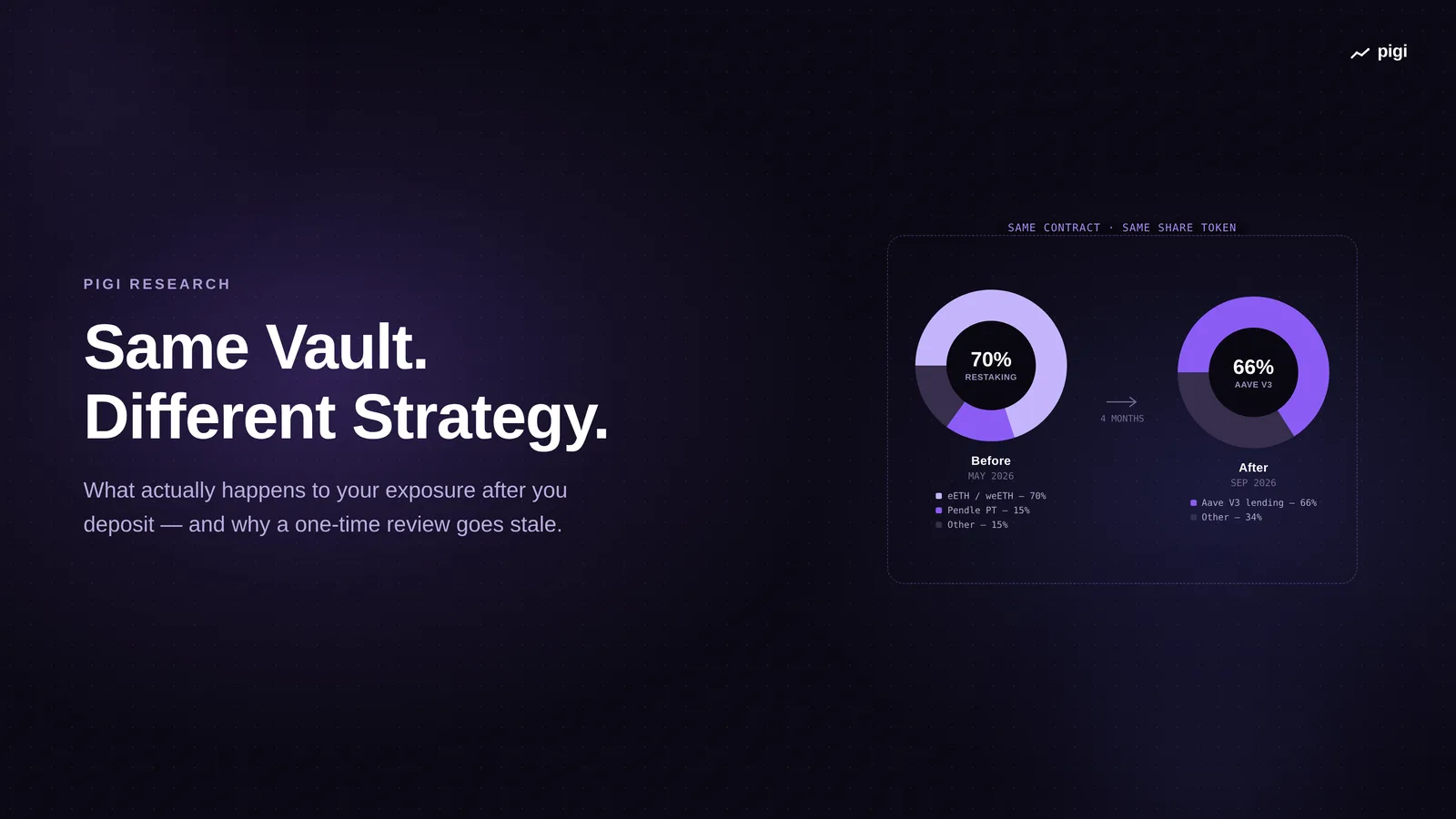
Before and after, four months apart: 6 of 35 strategies stopped being viable (two exploits, ~$31M), mid-cap synthetic dollars contracted 50-75%, blue chips ended flat — and Maple grew 81%.
A vault is not a fund. The second wave of ERCs standardizes the fund itself — series performance fees (8113), bounded manager mandates (8192), managed baskets (7621), fund metadata & NAV (8318 / uFund), tokenized reserves (7425), and generalized yield wrappers (5115).
ERC-4626 standardized the simple vault. A new generation of ERCs — 7540 async requests, 7575 multi-asset entry points, 7887 cancellation, 8161 transferable requests, 6229 lock-in rounds, 5143 slippage, 7535/7528 native ETH — is standardizing everything around it.
The US Treasury Bill is finance's risk-free rate. What a T-Bill is, how it's auctioned and priced, the two ways its yield is quoted, and the jobs it does across TradFi — plus why it's the honest benchmark for any DeFi yield.
Beyond APR, crypto projects reward users with points, airdrops and bonus campaigns. Why pigi.finance leaves that incentive layer out of its yield numbers — and where to find it.
We've updated the pigi.finance DeFi base rate. After April 2026's $304.7M in exploits, the stablecoin benchmark now averages four venues — the three Aave pools plus Liquity V2's BOLD Stability Pool — cutting single-protocol concentration.
A follow-up to article #7. How can an Aave pool show near-zero deposit APR and still hold $4B in TVL? Most depositors are not chasing yield — they are buying borrowing power. Wrapped eETH explained (as of 02.05.26).
Aave's USDC reserve has $1.93B supplied, $1.78B borrowed, and $153M available (as of 01.04.26). Why pigi.finance and DeFiLlama report different TVL numbers — and what each actually answers.
How insecure is DeFi really? We quantify protocol exploits as a share of TVL and compare them against FDIC bank-failure data from 2001 to 2025 — including the 2008 outlier.
AI gave us a clean implementation in seconds. Five weeks later we were still implementing it. A postmortem on memory limits, rebasing tokens, Uniswap V3 NFTs, Aave aTokens, and RPC rate-limit warfare.
On pigi.finance, "vault" covers ERC-4626 contracts, AMM liquidity pools, stability pools, and more. Learn how we define the term and why it matters for comparing DeFi yield opportunities.
Three numbers, three different questions. Learn what APR, APY, and CAGR each measure, when to use them, and how to compare DeFi yields without mixing apples and oranges.
Explore how derivatives like futures, options, and swaps are being reimagined as yield sources in DeFi, from funding rates to option premiums.
Interactive guide with sidebar navigation. Explore DeFi yield sources with easy chapter navigation and smooth scrolling.
We use cookies to improve your experience and analyze site traffic. See our Cookies Policy for details.