VAULT INFRASTRUCTURE
Same DeFi Vault, Different Strategy: What Happens After You Deposit?
The short version
- A DeFi vault can keep the same contract address and share token while the strategy underneath it changes materially.
- This is normal for allocator vaults: managers are supposed to move capital as yields, liquidity and risk change.
- The problem is that due diligence often happens only once — before the deposit.
- In our July review, ether.fi's Liquid ETH Yield vault was the clearest example: the wrapper stayed the same while the strategy shifted from a restaking-and-Pendle allocation to roughly two-thirds Aave lending. Re-checked in September, it had moved again: Aave is down to about a third, and the largest sleeve is now a stablecoin basis position that did not exist in July.
- Yearn's USDC-1 shows the same pattern by design. The contract persists while the allocator moves capital across four underlying strategies, two of which are themselves other vaults or markets.
- The practical lesson for LPs: don't ask only whether the vault is still live. Ask whether it is still the exposure you originally approved.
ether.fi allocations are from the Seven Seas vault API; Yearn allocations are from Yearn's yDaemon API. Both were checked on September 4, 2026 unless stated otherwise. This article is a dated snapshot — both vaults will have moved again by the time you read it, which is rather the point.
The vault looks the same
You deposit into a vault. Months later, your wallet still shows the same token. Same name. Same contract. Same protocol. It feels like the same investment.
But the portfolio underneath it may have changed completely.
That is one of the less obvious properties of modern DeFi vaults. Many vaults are not static strategies. They are allocation wrappers. The contract stays in place while a curator or allocator changes what happens underneath it. That can mean:
- moving capital between protocols;
- changing strategy weights;
- removing old markets;
- adding new ones;
- introducing new dependencies;
- changing the source of the yield.
For LPs, that creates a simple problem: the vault you diligenced at deposit may not be the vault exposure you hold today.
ether.fi: same wrapper, different machine — twice
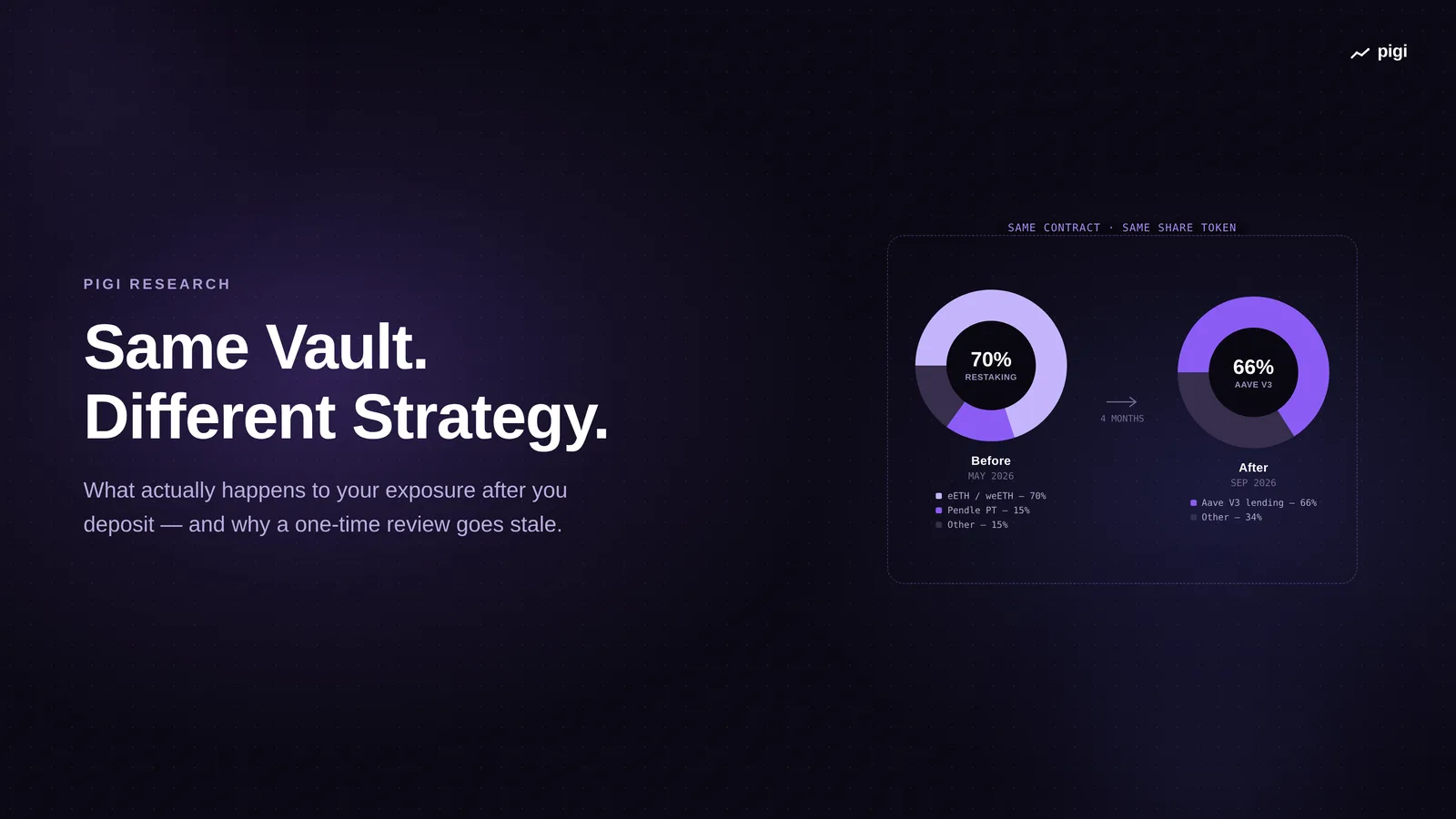
We saw a clear example in our July 2026 market review. At the earlier snapshot (late 2025 to March 2026), the ether.fi Liquid ETH Yield vault was roughly:
| Exposure | Earlier allocation |
|---|---|
| eETH / weETH | ~70% |
| Pendle PT | ~15% |
| Other positions | Remainder |
By July 27, 2026 the vault was still live and its wrapper had not changed. But the allocation had. Roughly two-thirds of the vault had become an Aave V3 lending position, while Pendle exposure had fallen below 1%.
Nothing failed. The manager simply changed how the vault was earning. That is exactly what an actively managed vault is supposed to be able to do. But from an LP's perspective, the economic exposure changed substantially. A depositor who originally understood the position as restaking exposure plus a meaningful Pendle allocation would no longer have an accurate description of what their money was doing.
Then we checked again while writing this article, six weeks later. The vault had moved a third time.
| Position (Seven Seas vault API, September 4, 2026) | Share |
|---|---|
| Stablecoin basis position (labelled "stables_basis" by the manager) | ~45% |
| Aave V3 lending | ~35% |
| Morpho | ~8% |
| Uniswap V3 LP | ~4% |
| SparkLend | ~2% |
| Fluid | ~2% |
| Yuzu (on Plasma) | ~2% |
Aave, the two-thirds position of July, is now about a third. The largest sleeve is a basis trade that was not in the vault at all in July. And about 2% of the vault now sits on a chain, Plasma, that was not part of the picture either.
Three snapshots, three different vaults. One address. The vault name survived every time. The strategy thesis did not survive any of them.
Yearn USDC-1: the contract is persistent, the portfolio is not
Yearn makes the same design explicit. USDC-1 (yvUSDC-1) is a Yearn V3 multi-strategy vault — what Yearn calls an allocator vault. The purpose of this architecture is to let deposits move across multiple underlying strategies while the user continues to hold the same top-level vault position.
On September 4, 2026 the vault held about $20M across four strategies:
| Strategy | Target weight |
|---|---|
| Yearn USDC (a nested Yearn strategy) | ~35% |
| stcUSD/USDC market (Cap's staked cUSD as collateral) | ~30% |
| USDC to USDS depositor | ~25% |
| USDC to sUSDS lender | ~10% |
The important part is not any single percentage. It is the structure. Two of the four sleeves are themselves other vaults or markets, so the exposure an LP actually holds is decided one layer below the vault they see in their wallet. And the allocator can change these weights, or swap a sleeve out entirely, without the LP's token changing.
An LP does not own "USDC yield" in the abstract. They own exposure to a changing set of strategies, markets and dependencies selected by the allocator. The wrapper provides continuity. The allocation does not.
For the allocator, that flexibility is useful. For the LP, it means the original diligence has a shelf life.
Three ways a DeFi vault can drift
Not every change is the same. There are at least three useful ways to think about DeFi vault strategy drift.
1. Allocation drift
The underlying strategies stay the same, but their weights move. For example, 60% Aave / 40% Morpho becomes 20% Aave / 80% Morpho. The building blocks remain the same. The economic exposure does not. A strategy that was previously diversified may become concentrated in one market without the vault address changing at all.
ether.fi between July and September is a live example: Aave went from two-thirds to a third.
2. Strategy drift
A strategy disappears or a new one is introduced. This is a larger change. The vault may now depend on a protocol, market or asset that was not part of the original due diligence. A new allocation can introduce new smart-contract dependencies, different collateral, different liquidity, different governance assumptions and different exit mechanics. The wrapper still looks familiar. The risk surface may not.
ether.fi's basis position is this kind of drift: a delta-neutral trade has a different failure mode from a lending book, and it was not in the vault when most of today's depositors did their homework.
3. Dependency drift
This one is easier to miss. A vault may allocate into another vault. That second vault can then change its own strategy. The top-level allocation may look unchanged while the ultimate economic exposure moves one layer below. The same principle applies when a strategy depends on changing collateral, external markets, curators or other protocols.
Yearn USDC-1's nested sleeves are the textbook case: the weights can stay fixed while what those sleeves hold changes. This is why reading only the wrapper is sometimes not enough. A vault is not an isolated contract. It is part of a dependency stack.
Drift is not the risk. Stale diligence is.
It would be easy to read this as an argument against actively managed vaults. It isn't. If rates change, liquidity moves or one market becomes less attractive, a good allocator should be able to react. That flexibility is often part of the product.
The problem appears when the investor's understanding stays static while the vault does not. Most DeFi vault due diligence happens before capital is deployed. The LP checks the curator, protocols, collateral, historical yield, liquidity and risk. Then the position becomes part of the portfolio. Months later, the share token is still there, so it is easy to assume the original diligence still applies. Sometimes it does. Sometimes it doesn't.
The July data already showed why this matters
Our July market review followed 35 DeFi yield strategies across roughly four months. Six — 17% — stopped being viable. Two were exploited. Others simply lost enough scale or liquidity to become economically irrelevant.
But complete failure was only the most visible kind of change. ether.fi showed the quieter version. The strategy survived. TVL held. Nothing dramatic happened. Yet the vault became a materially different portfolio underneath the same wrapper — and then did it again six weeks later.
For an existing LP, that can matter more than whether the current APY moved from 5% to 6%. The strategy may still be working. It may simply no longer be the strategy you originally approved.
The wrapper is persistent. The exposure is a state.
A product description is usually static: "ETH Yield Vault." "USDC Vault." "Stablecoin Strategy." But an actively managed vault is closer to a continuously changing portfolio. The name persists. The exposure does not necessarily persist with it. That means an LP needs to answer two separate questions.
- What is this vault allowed to do? Its mandate, allocator, permissions, strategy universe, limits and governance.
- What is this vault doing right now? Its actual positions, protocol exposures, strategy weights, assets, dependencies and liquidity profile.
Confusing the first with the second is where stale diligence begins.
What an LP should re-check
For an actively managed DeFi vault, the useful question is not "Is this still the same contract?" It is "Is this still the same exposure?" Five things are worth re-checking.
- Protocol exposure. Has capital moved into a protocol or market that was not material before? A familiar wrapper can now carry an unfamiliar dependency.
- Concentration. Has one strategy become a much larger part of the vault? A previously diversified strategy can become dependent on one venue without changing its name.
- Dependencies. Does the vault now rely on an asset, curator, oracle, protocol, chain or nested vault that was not important before? Problems do not need to originate inside the top-level vault contract.
- Liquidity and exit. Has the new allocation changed how easily capital can be withdrawn? A strategy can remain profitable while becoming harder to exit at size.
- Return. Did the strategy take on materially different exposure without delivering materially different yield? The question is not only whether the return changed. It is whether the risk required to produce that return changed with it.
Why this matters for DeFi vault risk
A vault risk assessment is a snapshot of a system. If the system changes, the relevant evidence can change with it. This is also why vault-level analysis matters. Protocol reputation alone is not enough. Two vaults can use the same protocol but have different curators, assets, strategy sets, concentration, dependencies and liquidity profiles. And the same vault can move between those exposures over time.
A persistent wrapper does not make the underlying strategy persistent. This is the difference between checking a vault once and actually understanding an allocation over time.
Takeaways
- Same vault does not necessarily mean same strategy.
- Active reallocation is often intentional and useful.
- Strategy weights, underlying markets, chains and dependencies can all change after an LP deposits.
- A one-time due diligence review can become stale even when nothing breaks. ether.fi's vault changed shape twice in the time it took us to write two articles about it.
- For existing positions, the important question is whether the current exposure still matches the original allocation thesis.
- The wrapper is persistent. The strategy is a moving target.
For live vault performance, historical yield and risk data, start with the leaderboards.
Related reading
- DeFi Yield Market Outlook: What Four Months Did to 35 Strategies — six of 35 strategies stopped being viable in roughly four months, while one surviving vault changed almost completely underneath the same wrapper.
- The Midnight Whale: Why Aave's USDC Rate Triples at 00:00 UTC Every Night — how one recurring wallet flow distorted a daily APR sample, and why historical yield methodology matters.
- Aave: 0% APR, but $4B in TVL? — why capital can remain inside a market even when depositor yield approaches zero.